Data Centre Infrastructure
What is required underground
Investment in data centre markets has been growing at an unprecedented pace over the past five years globally, with Australia emerging as the destination for global capital, supported by abundant land and growing access to renewable energy sources.
In May 2026, Westpac released a report estimating the investment pipeline across Australia will exceed $155 billion by 2035, encompassing both the data centre facilities themselves and the electricity generation infrastructure required to power them.
But why is the investment into this industry highly significant?
Data centres are considered critical infrastructure because they function as the nervous system of the modern economy, housing and processing the power and storage that keeps essential services running around the clock.
Today, there are more than 270 colocation and hyperscale data centres operating across Australia. Currently there are 93 in Sydney and 55 in Melbourne. Furthermore, there are more than 90 major projects proposed, approved, or under active construction, including but not limited to:
- Keppel Hazelwood Campus (VIC)
- GreenSquareDC (NSW & QLD)
- Firmus ‘Project Southgate’ (Regional)
- CDC Data Centres – Marsden Park Expansion (NSW)
- CDC Data Centres – Laverton Expansion (VIC)
- NextDC – West Footscray (VIC)
Additionally global giants such as Amazon Web Services (AWS) and Microsoft are progressing billion-dollar investment plans while Google is currently expanding its renewable energy assets including the Mulwala Solar Farm to assist in meeting their upcoming energy requirements into the future.
Over the next 10 years, it is estimated that the construction of the Data Centre infrastructure will account for approximately $70 billion, representing 35–45% of total project expenditure, as highlighted in the chart below.
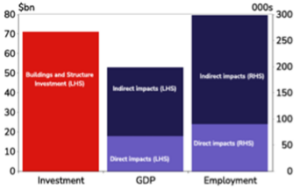
Source: Westpac IQ Report
What does this mean in practical terms to the civil and underground works component?
Australia’s data centre boom represents one of the largest sustained construction opportunities the sector has seen in a generation. For civil contractors, the scale of that figure is not just a headline, it translates directly into ground-level demand for trenching, pit installation, conduit systems, wastewater infrastructure, and electrical civil works, repeated across dozens of sites, simultaneously, over the next decade.
The question for contractors entering this space is not whether the work is coming, but whether the products, supply chains, and delivery capabilities are ready to meet the upcoming demand.
What Lies Beneath: The Underground Requirements
The cost to build underground infrastructure for a data centre is substantial. It must provide uninterrupted pathways for electricity, cooling water, and data, while protecting the facility from natural disasters and physical threats.
Construction requirements typically include:
- High-voltage trenching
- Earthing and grounding grids
- Chilled water piping
- Retention banks
- Precast concrete pits
- Reinforced concrete pipes
- Redundant fibre vaults
- Subterranean conduit banks
- Fuel tanks and subsurface fuel piping
- Haunching slabs
- Seismic isolation barriers
- Electrical pits
The scale of these works is considerable. Some data centres consume up to 40 million litres of water per day; this is the equivalent of the daily water usage of up to 80,000 Australian homes. These requirements place significant obligations on civil contractors that are working on these data centre projects to get it right, with many of these projects requiring their own bespoke wastewater, stormwater, and electrical infrastructure.
For example, a project that requires a bespoke stormwater or drainage system will need to consider sizes and quantities of precast concrete pits, box culverts, headwalls and lintels, pit covers and grates, kerb entry and road gully units, reinforced concrete pipes and trash screens are required to fulfill the project requirements adequately, or whether any custom solutions need to be drawn and built in conjunction with an engineering team who specialises in precast concrete solutions before work commences.
Data centre projects of this scale and complexity means the consequences of selecting the wrong underground infrastructure can be severe and expensive.
Incorrect stormwater, wastewater, or electrical pits can create a cascade of problems: non-compliance with local authority requirements, costly mid-construction redesigns, delays to commissioning, and long-term maintenance failures that compromise the reliability data centre operators depend on.
In a sector where uptime is everything, a compromised pit or conduit bank is not a minor inconvenience, it is a critical failure point.
Failure to forward plan compounds these risks significantly. Underground infrastructure is, by definition, one of the first elements installed and one of the last things that can be easily changed. A civil contractor who hasn’t accounted for the full scope of electrical, hydraulic, and data conduit requirements before groundworks begin will face retrofitting challenges that are disruptive, costly, and in some cases structurally problematic.
Coordination between hydraulic engineers, electrical engineers, and civil contractors must happen early, not as an afterthought. The message for contractors entering this sector is clear: the planning decisions made in the earliest stages of a data centre project have the longest-lasting consequences.
As the Australian data centre pipeline grows, so does the pressure on civil contractors to deliver durable and fit-for-purpose underground infrastructure that is with all relevant Australian standards including but not limited to AS3996-2019, AS3500 and AS3600, covering the load and capacity requirements for access covers and grates, plumbing and drainage products and the manufacturing of concrete structures.
Civilcast builds engineered products that address the core underground requirements of modern data centres including precast concrete pits, box culverts, headwalls and lintels, pit covers and grates, kerb entry and road gully units, reinforced concrete pipes and trash screens.
In a sector where the stakes are as high as Australia’s $155 billion data centre pipeline, the underground infrastructure is not a decision to be left to chance. We provide the certainty that projects of this scale demand.
For more information, reach out to the Civilcast team.
1300 012 278 | sales@civilcast.com.au | www.civilcast.com.au
